Are you rethinking your relationship with VMware in light of the changes Broadcom is making? | Gartner Peer Community
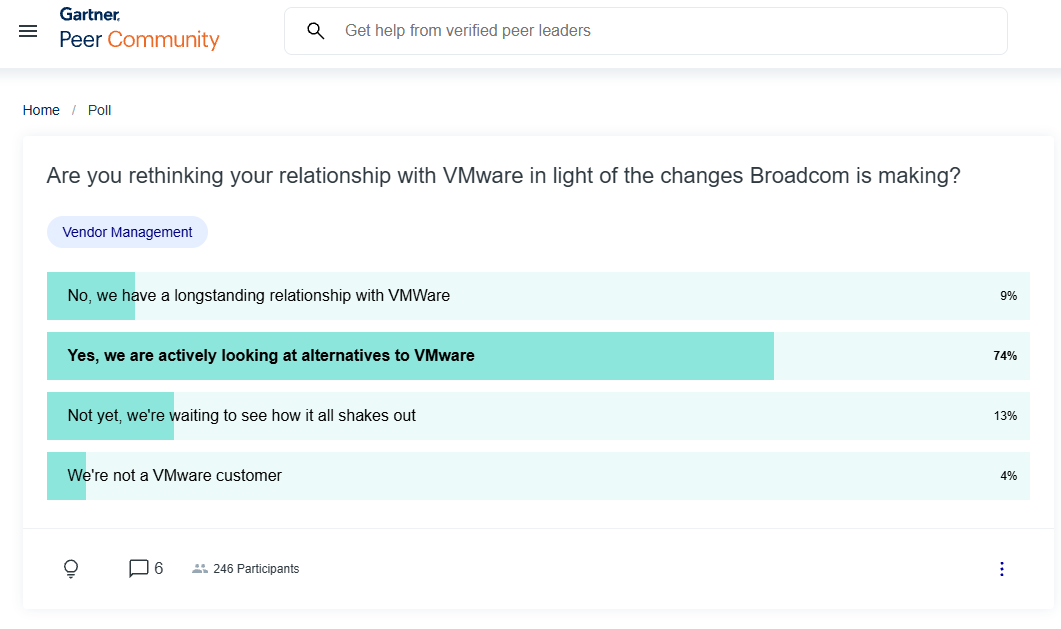
Business leaders are reconsidering VMware migration strategies and weighing other options. This poll presents real-world sentiment from 245 participants, showing that 73 percent are actively looking at alternatives. Review the poll to see how your peers are approaching VMware uncertainty, and contact Strategic Endeavor LLC to discuss what these shifts could mean for your migration planning.
Why are so many organizations rethinking their VMware strategy?
Many organizations are reassessing VMware because Broadcom’s changes are affecting both cost and licensing models.
From a recent peer poll with 257 participants in the Gartner Peer Community:
- 73% said they are actively looking at alternatives to VMware
- 13% are waiting to see how things develop
- Only 9% said they are not rethinking the relationship
The main drivers behind this shift include:
- Significant cost increases – some organizations are projecting a 2x–3x increase in renewal costs based on the new pricing.
- Move from perpetual to subscription licensing – this changes how budgets are planned and approved, and can increase long-term total cost of ownership (TCO).
- Broadcom’s acquisition track record – many IT leaders are cautious, given past experiences with other Broadcom acquisitions.
As a result, teams are not only looking at hypervisor alternatives, but also revisiting their broader infrastructure roadmap, including cloud strategy and vendor dependencies.
What VMware licensing and cost issues are peers running into?
Peers are seeing a mix of contractual complexity and rising costs as they approach renewals.
Common issues include:
- Sharp renewal increases – one organization’s analysis of its 2025 renewal showed a potential 2x–3x cost increase under the new pricing.
- Perpetual to subscription shift – customers who previously relied on perpetual licenses are now being moved to subscription-based models, which can raise ongoing operating expenses.
- Enterprise License Agreement (ELA) uncertainty – some customers have clauses in ELAs (for example, signed in 2021) that allow a one-year extension at a capped price, and they are unsure how enforceable or negotiable these clauses are under the new ownership.
- Scale-based licensing exposure – for example, one organization’s VMware Cloud Foundation (VCF) licensing is tied to 5,000 processor cores, so any per-core or bundle changes have a large financial impact.
To manage these challenges, organizations are:
- Right-sizing their VMware environments before renewal
- Actively benchmarking pricing and terms with peers
- Using renewal discussions as a trigger to evaluate alternative platforms
What alternatives and strategies are organizations exploring beyond VMware?
Organizations are not always abandoning VMware outright; many are reimagining how and where they use it, while also evaluating non-VMware options.
Common strategies include:
1. Hybrid cloud with VMware-compatible services
- Some teams are exploring Azure VMware Solution (AVS) as a way to keep a VMware-based stack while starting a hybrid cloud journey.
- This approach lets them reuse existing VMware skills and tools, move workloads to the cloud, and migrate back on-premises without refactoring applications.
2. Evaluating alternative hypervisors and platforms
- Organizations are looking at other hypervisors and network virtualization options to reduce single-vendor risk, including alternatives to NSX.
- Right-sizing and workload rationalization are often the first steps before any platform change.
3. Challenging vendor lock-in
- Teams are starting to question software vendors that require VMware as the only supported virtualization platform.
- The concern is that if VMware becomes more of a niche platform, the extra costs for specialized staff, hardware, and licensing will increase application TCO.
- This can trigger broader platform changes that go beyond just the hypervisor layer.
Overall, the trend is to rethink infrastructure strategy rather than make a rushed, one-dimensional switch. Many organizations are using this moment to reassess cloud adoption, vendor diversification, and long-term TCO.
Are you rethinking your relationship with VMware in light of the changes Broadcom is making? | Gartner Peer Community
published by Strategic Endeavor LLC
Strategic Endeavor, LLC, founded in 2013, is an emerging 8(A) and Service-Disabled Veteran Owned Small Business (SDVOSB) that specializes in providing management consulting, technology solutions, and administrative services to the Government and industry. Strategic Endeavor LLC is an approved Microsoft Cloud Provider and provides these services as an indirect seller in partnership with TD SYNNEX
SYNNEX Stellr Cloud Marketplace is a modern end-to-end solutions ecosystem that helps partners deliver more value to their customers. Strategic Endeavor LLC can leverage TD SYNNEX’s large number of state and local government and educational contracts and educational contracts-including NAPO ValuePoint and NCPA and NCPA directly on behalf of the manufacturers. Strategic Endeavor can also leverage TD SYNNEX GSA Schedule 58 and Schedule 70 to sell to the Federal government and its GSA Schedule SIN 511210 Software Publisher
Strategic Endeavor LLC provides the following Microsoft Solution
Microsoft 365
Helping customers build a modern workplace that allows them to work smarter and stay secure.
Office 365
+ migration services
Microsoft 365 + ISVs
+ managed services
Microsoft 365 + Azure Backup
+ DevTest + managed services
Azure practice
Azure migration, from defining a strategy to
migrating and optimizing
Contact: telephone 800-422-0381, Email: srhodes@seresults.com



 Sign in with LinkedIn